
Non-Contact Measurement: Why Optical Gauging Beats Calipers and Micrometers
Introduction: The Bottleneck in the Metrology Lab
Walk into almost any manufacturing quality lab, and you will hear the familiar click-click-click of digital calipers and micrometers. For over a century, these physical hand tools have been the gold standard for verifying dimensional accuracy.
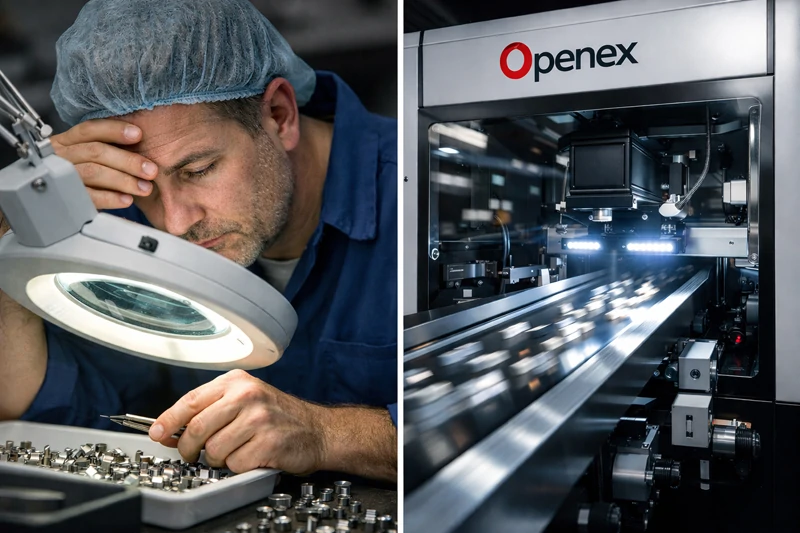
They are excellent tools for prototyping or low-volume spot checks. However, in the era of high-speed mass production, relying on physical hand tools introduces three massive risks: inconsistent readings, damaged parts, and severe production bottlenecks.
As manufacturers push for 100% inline inspection, the physical act of “touching” a part to measure it is becoming obsolete.
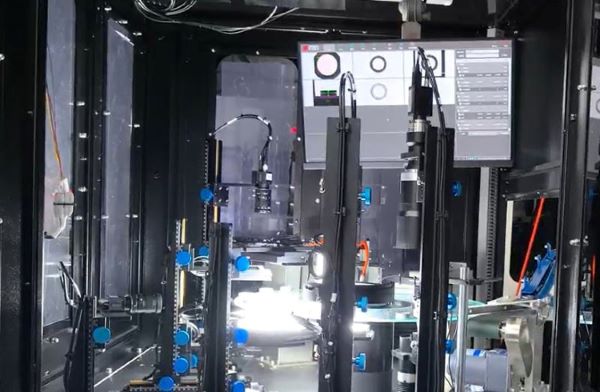
Enter Non-Contact Measurement via Optical Sorting Machines. By utilizing high-resolution cameras, telecentric lenses, and advanced algorithms, Openex Automation systems measure parts with micron-level accuracy without ever laying a finger on them. Here is why optical gauging is replacing traditional hand tools on the modern factory floor.
1. Zero Deformation: The “Soft Part” Problem
If you manufacture rigid steel blocks, a caliper works fine. But what if you manufacture rubber O-rings, thin-walled plastic tubes, or delicate electronic connectors?
The Physical Tool Flaw:
When a QC operator uses a micrometer on a soft or flexible part, the tool itself compresses the material. Even a slight squeeze can distort an O-ring by several microns, leading to a false “Fail” reading.
The Optical Solution:
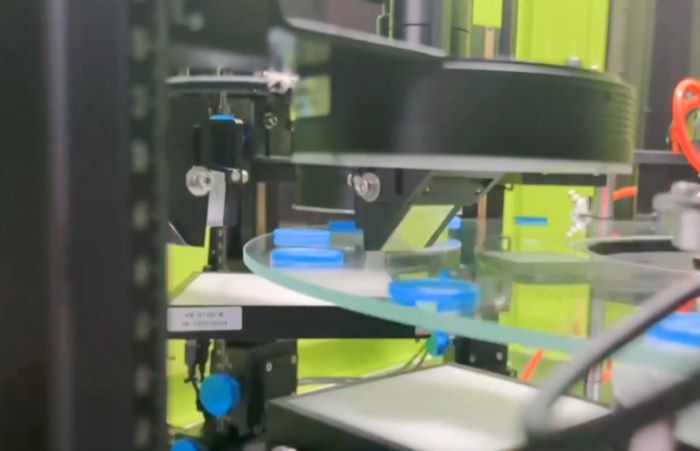
Optical gauging measures with light. Because there is zero physical contact, there is zero deformation. The part rests naturally on the glass plate of an Openex Optical Sorting Machine while cameras capture its exact, uncompressed dimensions. This makes non-contact measurement the only reliable way to inspect silicone, rubber, soft plastics, and thin-gauge stamped metals.
2. No Surface Scratches: Protecting Cosmetic Finishes
In industries like automotive interiors, high-end electronics, and medical devices, a part’s surface finish is just as critical as its dimensions.
The Physical Tool Flaw:
Dragging the hardened steel jaws of a caliper across a highly polished metal surface, a coated lens, or a painted component is a recipe for disaster. Manual measurement inherently risks scratching the part, turning a dimensionally perfect product into expensive scrap.
The Optical Solution:
With an Openex Optical Sorting Machine, parts move seamlessly through the inspection zone on a friction-free glass rotary dial or conveyor. The cameras take 360-degree images instantly. You get the precise metrology data you need without risking micro-scratches, scuffs, or contamination from human hands.
3. Eliminating Operator Variance (Gauge R&R)
In quality control, Gauge Repeatability and Reproducibility (Gauge R&R) is a critical metric. It asks: If three different operators measure the same part, will they get the exact same result?
The Physical Tool Flaw:
With manual tools, the answer is often no. Operator A might apply more pressure to the micrometer than Operator B. Operator C might hold the caliper at a slight angle. This human variance leads to inconsistent data and arguments over whether a borderline part is truly “Pass” or “Fail.”
The Optical Solution:
An automated vision system removes the human element entirely. The algorithms do not have “heavy hands.” Once calibrated, an Openex machine applies the exact same mathematical criteria to every single part. Whether it is measuring the thread pitch of a screw or the concentricity of a cylinder, the measurement is 100% objective, repeatable, and documented.
4. Unmatched Speed: From Minutes to Milliseconds
The ultimate limitation of physical tools is time.
The Physical Tool Flaw:
Manually measuring the length, head diameter, and thread pitch of a single bolt can take an experienced operator 30 to 60 seconds. Because it is so slow, factories are forced to rely on Statistical Process Control (SPC)—meaning they only measure 1 out of every 100 parts. If that 1 part is bad, the whole batch is quarantined.
The Optical Solution:
An Openex Optical Sorting Machine performs complex, multi-point measurements in milliseconds. Instead of measuring one part per minute, our machines can measure up to 1,200 parts per minute. This speed completely shatters the metrology bottleneck, allowing you to move from risky batch-sampling to 100% automated inspection. Every single part that goes into the shipping box is measured and verified.
Conclusion: Seeing is Measuring
Calipers and micrometers will always have a place on the engineer’s desk. But on the production floor, they are a liability.
By switching to the non-contact measurement capabilities of an Openex Optical Sorting Machine, you protect your delicate parts from deformation, prevent cosmetic damage, eliminate human error, and achieve inspection speeds that physical tools simply cannot match.
It’s time to stop touching your parts, and start capturing their data.
Next Week: We will explore why standard off-the-shelf machines don’t work for complex geometries in our post: Why “Off-the-Shelf” Sorting Doesn’t Work: The Need for Customized Solutions.
Upgrade Your Metrology Today
Are manual measurements slowing down your production or damaging your delicate parts? Contact Openex Automation today to see how our non-contact Optical Sorting Machines can automate your dimension verification.