Precision Redefined - Openex's Autonomous Phosphor Sheet Wafer AOI System
Introduction: The Micron-Scale Imperative
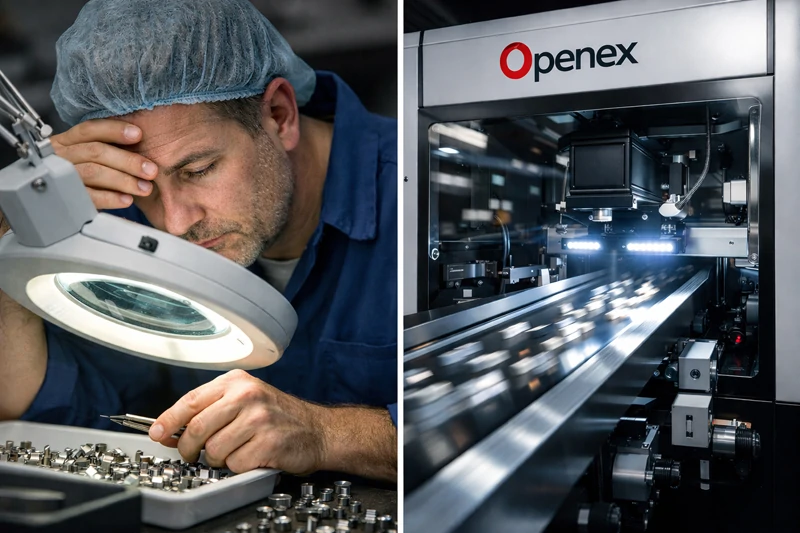
In advanced semiconductor packaging and optoelectronics, yield and reliability are decided on an invisible battlefield. Here, defects measured in microns can compromise multi-million dollar production lines. For years, manufacturers inspecting Phosphor Sheets on blue film wafers were constrained by a choice between costly, inflexible imported systems or inconsistent manual methods.
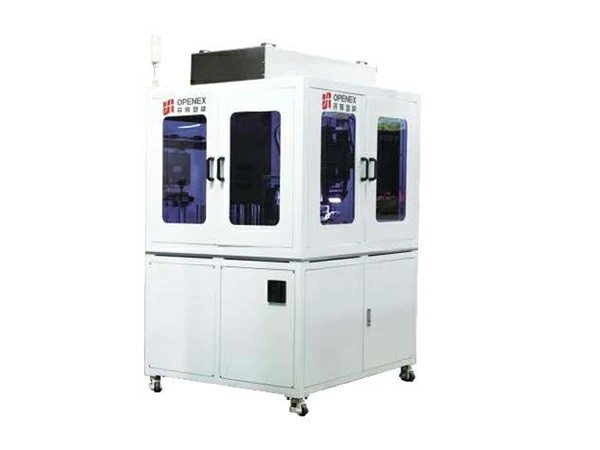
Openex Intelligent Technology redefines this landscape. We are proud to present our fully proprietary Phosphor Sheet Wafer AOI System. Engineered not merely to replace existing imported standards but to surpass them, this system combines state-of-the-art optics, robust mechanical engineering, and a hybrid AI vision algorithm to deliver unmatched detection accuracy.
This case study explores how Openex turns extreme inspection challenges into a competitive advantage for our partners.
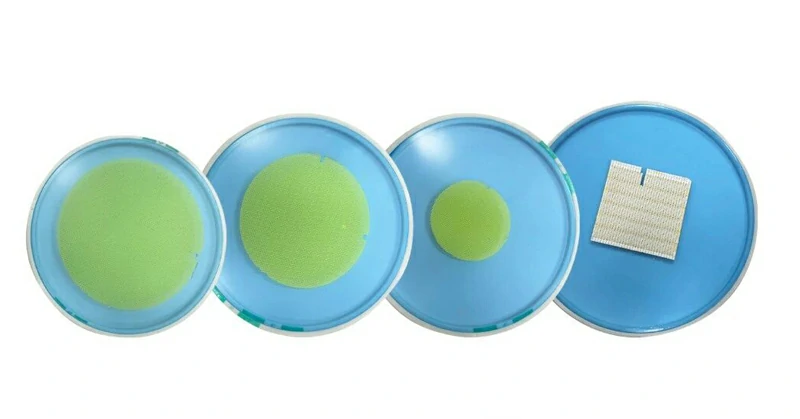
1. The Solution: A New Standard in Wafer Inspection
The Openex AOI system is engineered specifically for the post-cutting stage of phosphor sheets. It automates the detection of a wide range of surface defects—including foreign materials, air bubbles, dents, white spots, chipping, stains, and cracks—on components as small as 0.25mm x 0.2mm.
Key Capabilities:
- Micro-Precision: Detects defects down to 10 microns.
- Versatility: Fully compatible with 4-inch to 7-inch expansion rings.
- Wide Tolerance: Handles positional deviations up to 15mm from the ring center, ensuring coverage even on 60-115mm ranges.
- Cleanroom Ready: Integrated with an FFU (Fan Filter Unit) to maintain ISO Class 5/6 cleanliness.
2. Deep Process Innovation: Solving the “Impossible” Challenges
True innovation begins with a profound understanding of the problem. While standard AOI machines struggle with the variability of phosphor sheet manufacturing, Openex engineers solved four critical industry bottlenecks:
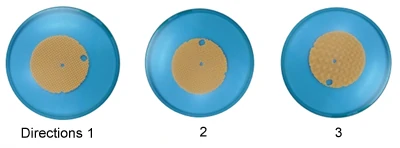
Challenge A: The “Random Orientation” Problem
The Issue: Incoming wafers often have no fixed rotational orientation. Traditional machines require complex mechanical turntables to physically align the wafer, which is slow and costly.
The Openex Solution: Our vision algorithms utilize the straight edges of the phosphor sheets to perform Automatic Edge Finding. The system performs instantaneous computational alignment, correcting for any rotation purely through image analysis.
Challenge B: Irregular Array Segmentation
The Issue: During the wafer expansion process, the grid of dies becomes irregular. Rows and columns are rarely perfect, making standard grid-based inspection algorithms fail.
The Openex Solution: Instead of assuming a perfect grid, our algorithm intelligently locates each die within distorted arrays. It treats each die as an individual unit of interest, guaranteeing 100% inspection coverage with zero misalignment errors.
Challenge C: The “Sticky Ring” Phenomenon
The Issue: Expansion rings stacked in a magazine often stick together. If the mechanical arm grabs two rings at once, it causes a machine jam.
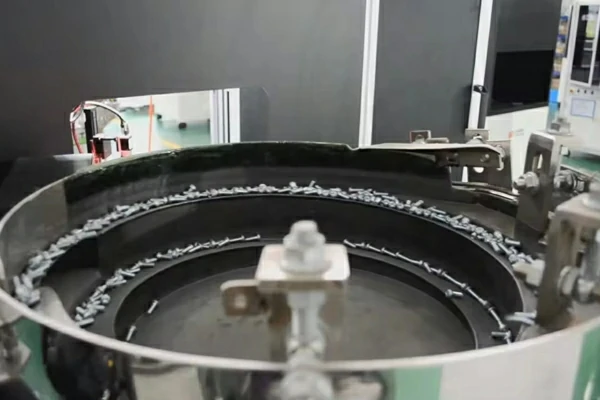
The Openex Solution: Our engineers developed a specialized mechanical structure that reliably separates adhered expansion rings during the pick-up phase. This simple yet critical innovation prevents jams and ensures the system can run unmanned for 6-8 hours.
Challenge D: The Throughput-Marking Bottleneck
The Issue: High-speed detection is futile without equally fast physical marking of defective dies.
The Openex Solution: We co-optimized the motion control S-curves with advanced path-planning software to achieve physical ink marking speeds exceeding 10,000 dots per hour. This enables true “detect-and-mark-in-one-pass” efficiency.
3. The Brain: Hybrid AI Advantage
We reject the “one-algorithm-fits-all” approach. Our proprietary vision engine strategically combines rule-based machine vision and Deep Learning.
- Traditional Algorithms (Geometric): Deliver blazing speed for well-defined defects like Edge Chipping.
- Deep Learning Models (AI): Trained on vast defect libraries, these models identify subjective defects such as Dents, Micro-bubbles, and Stains.
This hybrid approach, similar to the one used in our Ceramic Wafer Inspection Machine, maximizes both detection rate and accuracy, significantly reducing false calls.
4. Manufacturing Intelligence: Data & Traceability
The system acts as a data hub for your production line.
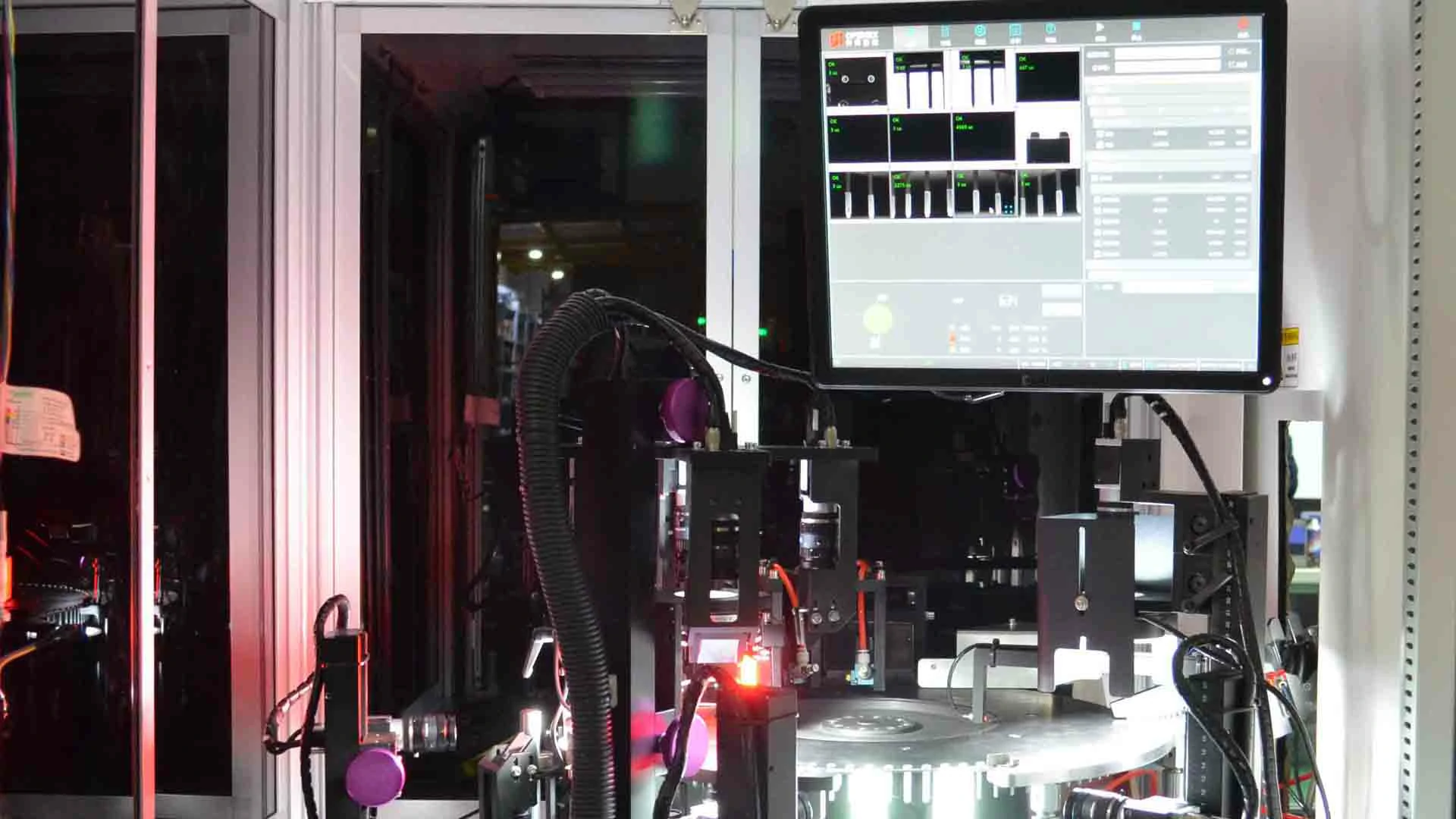
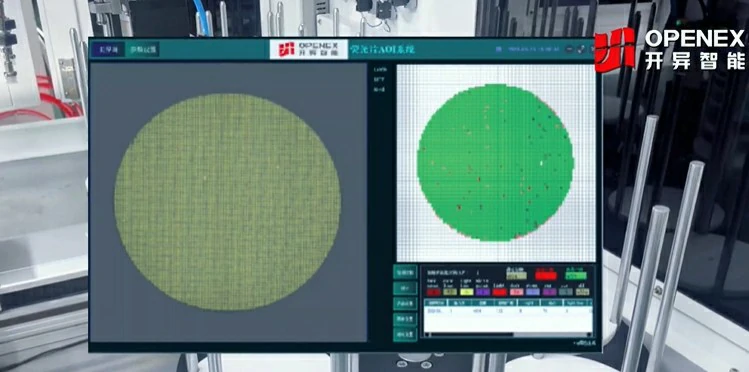
- Real-Time Visualization: The dashboard displays a stitched high-resolution image of the wafer alongside a live, color-coded defect map.
- Seamless Digital Handoff: The system generates standardized MAP files that downstream die bonders can read directly, allowing packaging equipment to automatically skip NG dies.
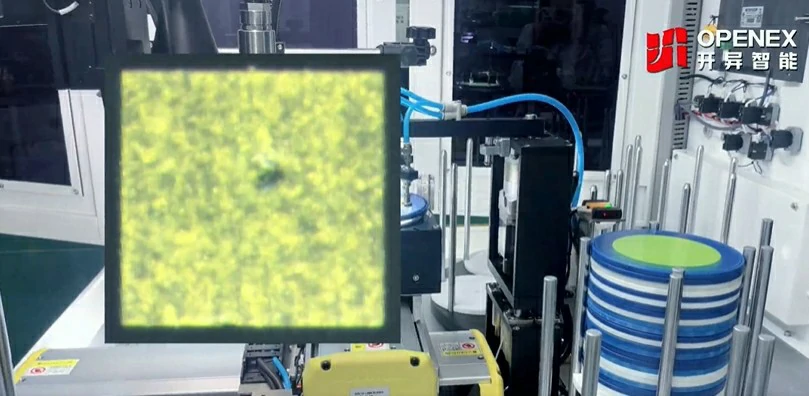
- One-Click Traceability: Operators can click on any NG point on the digital map to instantly review the high-resolution image of that specific die.
Conclusion: Partnering for Precision
The Openex Phosphor Sheet Wafer AOI System represents a new standard for what inspection can be. By marrying relentless engineering with intelligent software, we provide a solution that is faster, smarter, and more reliable than imported alternatives.
Ready to transform your inspection line?
Contact Openex Intelligent Technology today to schedule a consultation or sample test, and see how our deep innovation can be applied to your most pressing quality challenges.